Tuesday, 27 March 2018

Wagons for Longstone

Wagons for Longstone


There are several wagon kits for sale in the Smallbrook Studio and Sidelines ranges and I have collected a few of them (some still to be made) for use on Longstone.

These kits are usually made of resin and are supplied with wheels.  In the case of Smallbrook Studios  they come with tension lock couplings.  I have continued to replace the couplings with Kadee's.  The kits are basically a body moulding, chassis frame moulding, and wheels, - very simple to make.

The mouldings are thoroughly washed to clean off any residue, then glued together with superglue.  I have used Humbrol enamel primer, then Humbrol enamel matt top coats with added weathering, but I believe good quality acrylic paints can also be used.

 The Sidelines three plank open wagon kit.  Cleanly moulded and easy to assemble.

Vehicle No's 21 and 22 are Sidelines SL501 Covered Vans.

3-plank open wagons No's 25 and 26 are Smallbrook Studio kits running on "00" scale Dapol 10ft chassis. 

No. 29. This steel mineral wagon, which I bought ready-made from a friend may be a Rockley Bottom product from a few years ago.


No.30, A Tool Chest wagon, possibly from the same manufacturer.


No's 31 - 38.  Bulkhead Flat wagons made by Sidelines (SL201).


No.40, a Sidelines SL103 Tool wagon.


I bought this wagon, No.41 from Ebay and I believe it to be a Shapeways product.

No.42, a single plank version of the above.

No. 46, a old Sidelines SL502 3-plank wagon.


No.50 an old Sidelines SL500 flat wagon.


Another Sidelines model, SL007 Tank wagon, as yet to be numbered.


I hope to add a few more wagons to the LWR stock in the next few months.

Tuesday, 13 March 2018

Coaches for Longstone

Some more about the Coaches


"Jiro" with the first bogie carriage, No.12.

When I started modelling in 1:24 scale (April 2016) I found a distinct lack of passenger coaches in the kits available.  The type I wanted to model were enclosed, or semi-enclosed vehicles suitable for transporting visitors two or three miles.  As far as I could see, there was no way around it other than to build my own vehicles.

I had loads of 4mm Wills materials sheets from my 009 days, so I looked at the various types and decided to use them for building coach bodies along with Plastruct angle and Evergreen strips. The Wills sheets are quite strong, and over 1mm thick, so seemed ideal for building the bodies.  I mainly use the Tongue & Groove Boarding and Sheet Roofing sheets.

Coach livery is Humbrol Satin 195 "Dark Green" and 71 "Oak" Cream, with a mixed Cherry Red line and Matt 27 "Sea Grey" roofs.

The tension lock couplings are all removed from "00" scale chassis and replaced with Kadee couplings, sometimes the NEM362 type, depending on what fits best.

Kadee NEM coupling fixed on a Lima bogie.


Coach No.12 

I bought a second hand "00" scale Lima PTA wagon and removed the body.  This would be the chassis of the first coach, 148mm long.  Using thick 1mm plastikard for the floor, I used 6mm Plastruct angle to create a frame around it as a basis for the body sides.  Then using the Wills materials built up the body, meticulously creating window frames from old Peco mouldings from a Station House kit, and using thin clear "Plastiglaz" for the window glasses.  The removable roof is held in place by two brass pins, so I can access or re-position passengers.

  The first bogie coach under construction, using the Wills materials sheets.

The completed bogie coach with "Proteus".


Being new to the scale I sized the coach as best I could, I was pleased with it, and initially the coach appeared the right size.  But when I ran it with other items of stock, it seemed to dwarf everything.  So the decision was made to re-build it lower and narrower.

Un-daunted, I dismantled the coach three months after I built it.

A photo in the workshop being re-built.

Newly re-constructed coach 4mm narrower and 7mm lower with stronger glazing too.

The coach is more in proportion to other items of stock now and runs well.

Coaches 14 & 15

Next, two 4-wheeled coaches were built in the same way, with the Wills materials.  These would be open above the waist and sit on "00" scale Dapol 10ft Wagon chassis.  The bodies are 75 mm long x 68 mm high and 50 mm wide.

Another workshop photo, with one of the four-wheeler's under construction.

The completed vehicles on the maintenance shed diorama.  Roof's are detachable, and held in place by "L" shaped brass pins.  Couplings are Kadee NEM  pocket type.

Another photo on the maintenance shed diorama being hauled by "Proteus".

I built the bodies to the same height and width as the re-built bogie coach, but because they sit lower down on the wagon chassis they looked too low, with the roof line about 5mm lower than the bogie coach!  So, after much deliberating, I am at present re-building these too, saving as many parts as I can for re-use.

Here is coach No.15 before re-painting with new end panels and raised sides.  I have decorated the cant rail to detract from the vehicles"boxiness".

This photo shows the height difference with original coach 14 of the same type, and No.15 is now more in proportion with other passenger stock.


Completed re-built coach No.15


Coaches 16 & 17

In mid 2017 Smallbrook Studio introduced a coach to their range of Heywood kits it was called a Decauville Inspection Coach, a lovely kit, full of character.
Link to: Smallbrook Studio Gn15 Heywood Kits
It is probably designed for engineers to travel the line and check-out the condition of track and works areas.

I saw it as a new passenger vehicle, and my wife bought two of these kits for a birthday present.  They are very tall, so I reduced them in height by 10 mm, reducing end windows, and they are now in service.

Another workshop photo.  The Decauville coaches being prepared for painting.

Coach No.17


The pair of completed coaches.


Coach No. 20

Another "workshop" image, showing the body of coach No.20 receiving paint. 

Coach No.20 is a model made from card.  It started off as a kit by "Norfolk Heath Works" - a bogie passenger/open wagon vehicle.  I added a guards compartment where the open wagon section should have been, and also added a roof.  The curly valance is York Modelmaking 7mm scale canopy valancing.

The coach when completed.

It is mounted on some  Parkside Dundas PA38 LNER Diamond Frame bogies, which I found were tricky to mount the wheels in.  They were too loose and wouldn't hold in the bogie frames, so the only thing to do was glue-in some brass bearings.  I am still not happy though as the coach isn't a very good runner.  I may have to get some other bogies for it.

No.20 seen on the Longstone Maintenance Shed diorama.


Coach No. 11

I liked the general idea of coach No. 20 with half passenger compartment and half guards cabin, so decided to make a plastic model of a similar type of vehicle, built in the same way as bogie coach No.12 using the 4mm Wills Materials.

Some of the main parts for the new vehicle.  Part made body, guards van sides and a Lima PTA wagon chassis with new Kadee couplings.

The vehicle under construction, March 2018 .

Above and below: The completed coach on the maintenance shed diorama.


Wednesday, 28 February 2018

Longstone

Longstone

(21st layout)

An early photo of the village board.


Here is summary of the layout with some early photographs. 

Legend

The fictitious layout "Longstone" depicts an 15" gauge estate railway 3.25 miles long.  It runs from Longstone village southwards to Hobground sidings alongside the standard gauge York to Scarborough line near the village of Whisperdales, entirely within the estate owned by Lord Mitchell who took over ownership of the woollen mill at Spring Head.  The line started as a horse tramway in the late 19th century for transporting supplies, coal and products to and from the mill and was gradually improved by it's previous owner for use as a railway.

From the Longstone Hall maintenance shed the line runs into the village station, at 1/4 of a mile there is a small halt at Spring Head (Mill), and, running over moorland at 1 1/2 miles (the steepest part of the line), the village of Dalebrook is reached where there is a passing loop and siding.  Attaining a low lying valley at 2 1/4 miles High Bank Farm is reached where there is a farm siding, then proceeding along the lowest part of the line by the Whisper Beck and after another mile the end of the line is Hobground (for Whisperdales village).

(Click on images to enlarge)

Loco No.1 "Proteus" in the rock cutting at Fox Gill. 

The small railway has many sources of traffic: supplies, coal and raw wool to the mill, and woven products leaving the mill, mill workers transport, guests to Longstone for "Longstone Hall" and gardens, and also visitors and walkers for the moors area around Longstone.

"Proteus" again, seen leaving the mill sidings with a goods train. 
 It is about to go through the "hole in the sky" which leads to the village station.  
On the back scenes we have used cut-up Yorkshire calendar pictures to give more depth to the scenes.

The Layout

The layout shows three scenes, the village with station, Fox Gill and moorland area, and Spring Head Mill.  It is viewed on three sides, with a fiddle yard and operating area on the fourth side.

At present I have five Smallbrook Studio locomotives:
No. 1 "Proteus" - a Harlequin kit, and the loco that started it all.
No. 2 "Jiro" - a Columbine kit.
No. 3 "Triton" - a Pierrot kit.
No. 4 "Delta" - another Columbine kit.
No. 5 "Quinto" - a modified Katie kit.

The wagons are a mix of Sidelines (Black Dog Mining/Pepper7) and Smallbrook Studios kits.

Coaches are mainly scratch built, but include two Decauville open sided 4-wheeler's by Smallbrook Studio.

I hope to add a later post with details of the locomotives and stock.

This is the passenger shelter just after completion with loco No.4 "Delta" passing by on test.
The wooden fencing in the foreground is a Lemax product.

No.3 "Triton" in the mill yard with general supplies for the mill.

Baseboards are made of 6 mm and 9 mm ply wood.  Two baseboards are 39" x 22" (1000 mm x 550 mm) and are supported by built in legs.  They are the fiddle-yard and Fox Gill boards.  The village and mill boards are suspended between them and are 43" x about 19" each (1090 mm x 490 mm), but the mill board is slightly wider to get the turnout to the mill fitted in.

Track on the scenic sections is Peco "0-16.5" Streamline, and in the fiddle yard is Peco "00" Setrack.  The turnouts in the fiddle yard are controlled by Peco PL-11 Side Mounted point motors, and in the scenic sections we use Tortoise Slow Motion Machines. 

The first scene constructed, at the village stores.  
The street lamp is an altered Lemax product, and the post box is one of the "Miniature World" stone resin items.

A longer view of the village board while the station was under construction with "Triton" and empty wagons.  

No.4 "Delta" shunting at the mill rail entrance.

"Proteus" is seen crossing the bridge at Fox Gill.  
We later added some low trees, sheep and other animals to the scene.

"Proteus" again, with bogie coach arriving at the newly constructed station.
I wasn't happy with the back scene picture of Longstone Hall above the bridge, so later we changed it for another building.

"Triton" passing the end of the road in the village.
The chapel was an amalgamation of several Yorkshire chapel features from photographs.


Friday, 23 February 2018

Figures, Animals and Birds

Figures, Animals and Birds


The first three figures I bought by Modellers Resource, and a Henry Ford & Co worker from the ICM kit.

Trying to get 1:24 scale figures and animals was a bit of a worry at first.  My first and only purchases were three workshop figures by Modellers Resource, these could be used as loco drivers or as mill workers, they are resin kits and can be positioned on many poses.  Many of the other figures I could find were proper "G" scale items, being 1:22.5 and therefore some being too large.  

However, it has been fun trying to source other suitable makes through the internet with the help of the GnATTERbox forum (Gn15info forum) and now I have several manufacturers products:
Modellers Resource, Prieser, ICM (Henry Ford  & Co kit), Graupner, Chalk Garden Rail, Deans Marine, Bachmann, Lemax, SLM online, and cheap figures from the internet of Chinese manufacture.  I have also found one or two second hand figures of unknown make at toy fairs and model railway exhibitions.

Some figures from these manufacturers are not exactly to scale, being slightly too small (or large!), but with careful placing some can look acceptable.

I haven't yet got my system of painting them good enough though, but I'll keep trying. "Eyes" seem to be the main problem for some reason.

US, SLM online figure.

This (under scale) old lady is a re-painted Lemax figurine. 

Examples by un-known make, Graupner, Prieser, Modellers Resource and Deans Marine.

A cheap Chinese figure which has good detail and re-painted well.

Another selection, by Chalk Garden Rail, Prieser, Deans Marine, Chinese and also unknown make.

First lady figure, by Prieser.

Another figure from the ICM Henry Ford & Co kit, as yet un-painted.


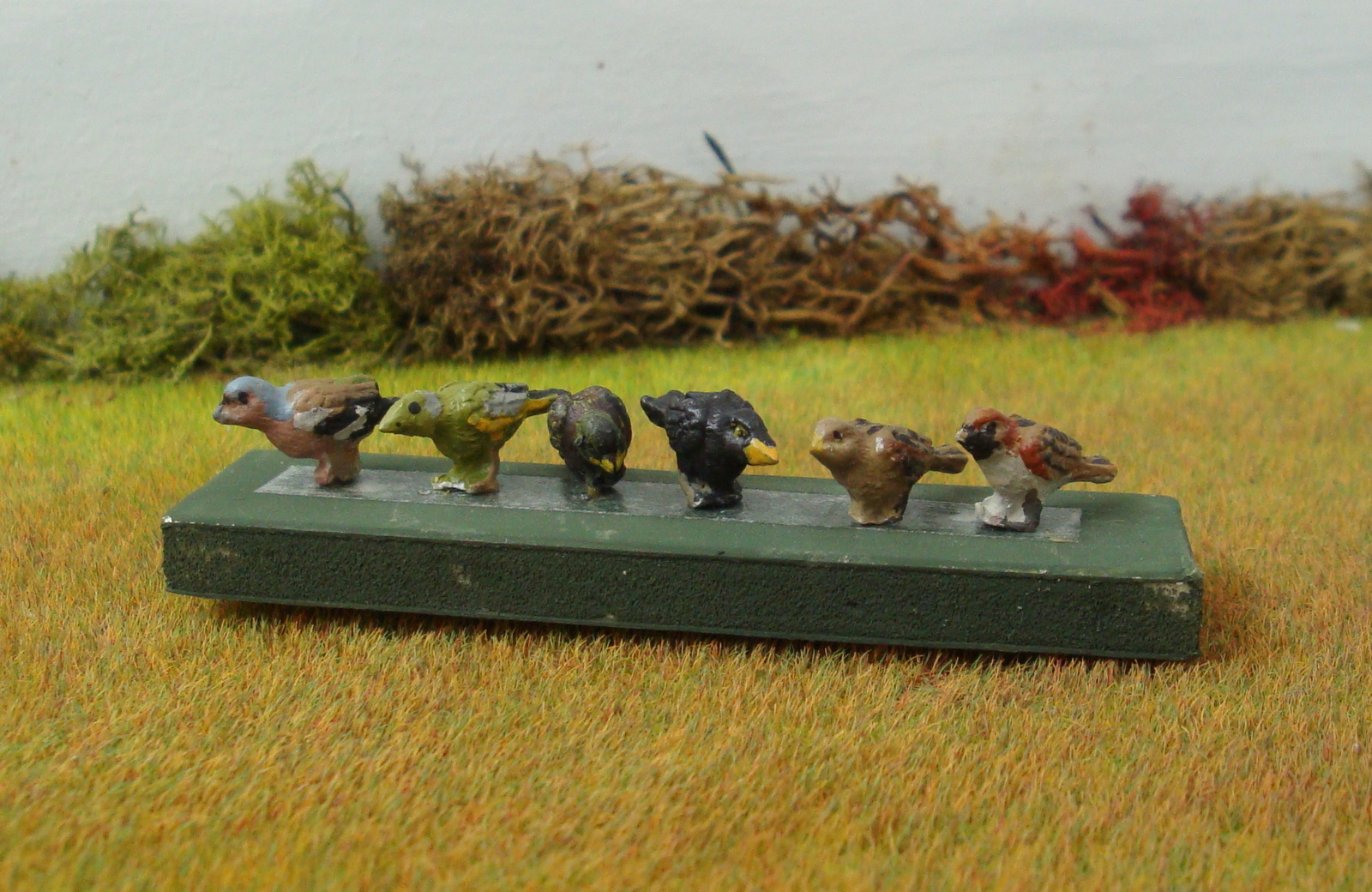
Animals and birds are hard to find.  I have some Prieser sheep, but they look like a continental breed and I had to alter them a bit to look more British.  Other sources are: some "toy farm" animals re-painted, "Miniature World" items from garden centres, though some of these are over-scale, and animals and birds cut off Lemax figurines, this though can be a bit tricky, then re-painted. 

Sheep by Prieser, some Lemax squirrels, items from Miniature World and a toy farm dog.

Lemax mouldings cut from various figurines and re-painted as chaffinch, green finch, starling, blackbird, and sparrows.

These crows came from a Lemax "Spooky Town" set.

More Lemax items removed from figurines, and painted as a jay and a collared dove.

All the above figures, animals and birds are now fixed to "Longstone".